OverWise

Market regime, November 26

Top five drivers, the risk matrix and the book for Thursday, November 26, 2026.

Label change. CAUTION to NEUTRAL.

Read the five drivers
Before the US open Next review 27 Nov 2026 (Fri)

Regime score

43of 100

NEUTRAL

2 under CAUTION, 13 over the RISK-ON line

0 to 29 risk-on · 30 to 44 neutral · 45 to 60 caution · 61 and up risk-off

This is a Thursday morning note. The US equity market is closed for Thanksgiving. Wednesday's cash close is the book. The score is 43 of 100, down from 45. The label is NEUTRAL. Yesterday it was CAUTION. NEUTRAL runs from 30 to 44. CAUTION runs from 45 to 60. RISK-ON is below 30. RISK-OFF starts at 61. A higher score means more stress. Two points crossed the line. The volatility index rose. This is a label change. It is not an easier tape.

Wednesday was a rescue inside the session, and a small loss at the close for the S&P 500. The index closed at 7,182.78, down 18.31 points, or 0.25 percent. At the low it was 3.2 percent under Tuesday's close. The Dow closed at 50,182.95, up 164.25 points, or 0.33 percent, after trading about 1,105 points under Tuesday's close. The Nasdaq composite closed at 23,585.80, down 147.73 points, or 0.62 percent. Nvidia closed at 149.30, down 3.9 percent. Brent futures settled at 94.61 dollars, up 3.21 dollars, after a claimed strike on Saudi Arabia's largest refinery. October prices and the second estimate of third quarter output printed. Core prices are 3.3 percent above a year ago. A December rate increase of a quarter point is priced at 98 percent in the morning wire. The findings that were only expected on Tuesday are now a proposal, with caps, and they are not in force. A Thursday screen in Asia, and a futures print, are not a new US close. There is no US crude settlement today.

In short

MARKET REGIME, Nov 26 (Thu)

Signal. Do not add stocks on the label change. Score 43 of 100.

  1. United States The label flipped to neutral. Volatility still rose.
  2. United States October core prices are 3.3 percent above last year.
  3. United States New tariffs are capped and delayed. They do not stack.
  4. Iran A Saudi refinery attack lifted the oil settlement.
  5. United States Nvidia fell 3.9 percent yesterday. Chips still leaked.

Markets bar

Equity, fund, and volatility rows are Wednesday's cash close, against Tuesday. Yield index rows are Wednesday's close on this series. The Brent row is Wednesday's settlement on the contract that settled Tuesday at 91.40 dollars. The US crude row is Wednesday's settlement on the contract that settled Tuesday at 82.05 dollars. The dollar index row is this series' Wednesday bar. The gold row is the fund. A Thursday screen is not this table. The morning oil screen sits under the table, not in the cells.

The score uses Wednesday's volatility index of 28.29 and Wednesday's 10 year index of 4.848 percent. A cash wrap had the 10 year yield down 6.2 basis points to 4.84 percent. That is a different print of the same day. The table uses this series.

On this series the dollar index was unchanged at 103.81. A Wednesday close story had the dollar index down 0.14 percent, and a Thursday morning wire had it near 103.71. Those are other prints. The table uses this series.

By 0137 GMT on Thursday, Reuters had Brent futures at 94.71 dollars, up 10 cents from Wednesday's settlement, and the US contract at 84.03 dollars, up 35 cents from 83.68. An earlier Thursday wire had Brent futures at 94.83 dollars and the US contract at 84.10. Two screens, twelve cents apart on Brent. Neither is a settlement. There is no US crude settlement on Thursday.

The continuous feed on this series printed a Brent close of 91.05 and a US crude close of 84.33, on volumes far below the prior session. That feed is not the settlement row.

Asset Level Change
S&P 500 (Wed close)7,182.78Down 18.31 points, or 0.25 percent, vs Tuesday
Nasdaq Composite (Wed close)23,585.80Down 147.73 points, or 0.62 percent, vs Tuesday
Dow (Wed close)50,182.95Up 164.25 points, or 0.33 percent, vs Tuesday
Russell 2000 (Wed close)2,704.06Up 0.7 percent vs Tuesday, on this series
VIX (Wed close)28.29Up 1.93 points vs Tuesday
US 10 year yield index (Wed close)4.848 percentDown 5.6 basis points vs Tuesday
5 year yield index (Wed close)4.660 percentDown 5.2 basis points vs Tuesday
30 year yield index (Wed close)5.235 percentDown 5.7 basis points vs Tuesday
3 month yield index (Wed close)4.155 percentDown 1.3 basis points vs Tuesday
Brent, Wednesday settlement94.61 dollarsUp 3.21 dollars, or 3.5 percent, vs Tuesday
US crude, Wednesday settlement83.68 dollarsUp 1.63 dollars, or 2.0 percent, on that contract
Dollar index (Wed bar)103.81Unchanged from Tuesday's 103.81 on this series
Gold fund (Wed close)327.45Up 0.6 percent vs Tuesday
Energy fund (Wed close)60.90Up 0.7 percent vs Tuesday
Oil fund (Wed close)139.89Up 3.3 percent vs Tuesday
Semiconductor fund (Wed close)422.46Down 1.0 percent vs Tuesday
Semiconductor index (Wed close)8,774.86Down 0.65 percent vs Tuesday, on this series
Nvidia (Wed close)149.30Down 3.9 percent vs Tuesday
Broadcom (Wed close)300.86Down 0.1 percent vs Tuesday
Advanced Micro Devices (Wed close)406.03Down 1.8 percent vs Tuesday
Micron (Wed close)601.25Down 4.5 percent vs Tuesday
Dell (Wed close)297.06Up 0.6 percent vs Tuesday
Long bond fund (Wed close)82.24Up 75 cents vs Tuesday
High yield fund (Wed close)76.52Up 9 cents vs Tuesday
Investment grade fund (Wed close)104.29Up 50 cents vs Tuesday
Large cap China fund (Wed close)31.30Down 0.4 percent vs Tuesday
Emerging markets fund (Wed close)56.40Down 0.5 percent vs Tuesday
S&P 500 fund (Wed close)716.70Down 0.3 percent vs Tuesday
Nasdaq 100 fund (Wed close)633.93Down 0.7 percent vs Tuesday

Top five drivers

United States The label changed

The tape did not ease.

SignalThe score this morning is 43. Yesterday's note had 45. The label moved from CAUTION to NEUTRAL. Flow is 69, up from 62, because the volatility index closed at 28.29, up 1.93 points from 26.36. Fiscal is 52, down from 54. The central bank line is 38, down from 40. Narrative is 2, down from 17. The narrative drop, with a small ease in the fiscal and central bank lines, outweighed the rise in flow. That is how two points crossed the band. The volatility index did not agree with the label.

The close was a rescue, not a repair. The S&P 500 closed at 7,182.78, down 0.25 percent. Its low, 6,970.11, was 3.2 percent under Tuesday's close. The Dow closed at 50,182.95, up 0.33 percent, after a low about 1,105 points under Tuesday's close. The Nasdaq composite closed at 23,585.80, down 0.62 percent. Its low was 4.6 percent under Tuesday's close. Reuters said the Nasdaq fell more than 4 percent early, and that the Dow finished higher after the hole was filled. The Russell 2000 rose 0.7 percent, to 2,704.06 on this series.

Breadth said the washout list got worse even as advancers led the close. On the New York Stock Exchange, Reuters counted 54 new highs and 629 new lows. Tuesday had been 58 new highs and 309 new lows. Advancers outnumbered decliners by 2.04 to 1 on the exchange. On the Nasdaq, 44 new highs and 479 new lows, with advancers ahead by 1.44 to 1. Volume was about 22 billion shares, and Reuters said that was lower than average. Early in the day the Nasdaq 100 briefly fell 20 percent from its record closing high. The close was not that print. Reuters said the Nasdaq composite is down 7.3 percent for the month.

The cash market is closed today. Friday is an early close. A Thursday rally in Asia is a morning print. Reuters had European futures higher, the Nikkei up 1.6 percent, South Korea up 1.9 percent, and S&P 500 futures up 0.6 percent when that story was filed. Those sessions were not a US close.

Macro ImpactBuying the book because the label flipped treats a two point cross, on a day volatility rose and new lows widened, as a new regime. Selling the book because the morning hole was deep sells a close that already filled most of it. The next cash test is a short Friday, and then Monday.

PositioningDo not add broad equity. Wednesday's close is the book until the next cash session prints. Cash still pays to wait through a shut market and a short Friday.

Key SourcesReuters, 25 Nov, https://www.reuters.com/business/nasdaq-futures-slide-over-2-fresh-us-tariff-concerns-inflation-data-focus-2026-11-25/ ; Reuters, 26 Nov, https://www.reuters.com/world/china/global-markets-global-markets-2026-11-26/ ; Wednesday closes on this series.
United States The price print was hot

Bonds rallied anyway.

SignalThe second estimate of third quarter output was revised to a 4.3 percent annualised rate, from 3.4 percent. Economists polled by Reuters had expected 3.5 percent. It was the fastest pace since the third quarter of 2023. The prior quarter was 2.2 percent. Consumer spending was revised to a 4.2 percent rate, from 3.8 percent. Business spending on equipment was revised to a 21.8 percent rate. Final sales to private domestic purchasers, the demand measure policymakers watch, accelerated to a 5.8 percent rate, from 4.9 percent.

October prices rose with that demand. The personal consumption expenditures price index increased 0.3 percent in October and 3.8 percent from a year earlier, after 3.6 percent in September. Core prices, excluding food and energy, also rose 0.3 percent on the month, a third straight month at that pace, and 3.3 percent from a year earlier. That is the largest yearly core gain since November 2023, and a tenth above the 3.2 percent some economists had penciled in before the release. The prior yearly core rate was 3.1 percent.

Initial claims for unemployment benefits fell 13,000 to 189,000 in the week ended 21 Nov, against a poll of 200,000. The report was brought forward a day because of the holiday. A stable labour market, in Reuters' reading, leaves room for further rate increases after December.

The policy rate is 3.75 percent to 4.00 percent. Reuters said markets have priced a quarter point increase at the 8 Dec (Tue) to 9 Dec (Wed) meeting, and are expecting another increase in January. The Thursday morning wire put the December quarter point at 98 percent, and said talk of a half point increase has faded. A governor had earlier said he could support a half point move. Economists told Reuters the equity selloff had reduced the need for that larger step. The print did not retire the argument inside the central bank. Staff have treated much of the overshoot as supply. Several policymakers still point at demand, and at spending on artificial intelligence, as a reason to keep hiking.

Yields fell on the same day. The 10 year index closed at 4.848 percent, down 5.6 basis points. The 5 year index closed at 4.660 percent, down 5.2 basis points. The 30 year index closed at 5.235 percent, down 5.7 basis points. The long bond fund closed at 82.24, up 75 cents. Reuters' cash wrap had the 10 year yield down 6.2 basis points to 4.84 percent, and the Thursday wire called 4.848 percent an 11 week low. The score uses the index, not the cash wrap. The bond bid is a flight from the equity hole. It is not a change in the hike.

Macro ImpactAdding duration because the 10 year index fell 5.6 basis points treats a holiday eve flight as a peak in yields. Adding equity because growth was revised up to 4.3 percent ignores the price print that keeps the hike in the price. The two trades fight each other, and neither one is Wednesday's close.

PositioningDo not cover the long bond. Do not add it. A December quarter point is the priced move. Cash and short bills still pay more than a label change.

Key SourcesReuters, 25 Nov, https://www.reuters.com/business/us-inflation-rises-further-october-2026-11-25/ ; Reuters, 25 Nov, https://www.reuters.com/world/us/us-weekly-jobless-claims-fall-more-than-expected-2026-11-25/ ; Reuters, 26 Nov, https://www.reuters.com/world/china/global-markets-global-markets-2026-11-26/ ; Wednesday yield index closes on this series.

United States The tariff file is a proposal

It is capped, and it is not in force.

SignalOn Wednesday the administration proposed new tariffs on 14 trading partners, including China, Japan, and the European Union. Tuesday's note had the findings as expected, and not released. They are released as a proposal. Mexico and Norway, which were in the wider probe, were left out because those investigations are still open. That is why the count is 14, not 16.

The proposed maximum rates run from 20 percent to 40 percent. The trade representative said the office intends to cap the new tariffs at lower levels in deals that are done or still being negotiated. China would face a capped rate of 20 percent, on top of duties of roughly 25 percent from the first term. That cap fits a truce that expires on 10 Jan (Sun). If the truce unravels, the Chinese rate in this file would rise to 40 percent. India would face 17 percent if a deal is finished, and 25 percent if talks fail. Vietnam would face 20 percent with a deal, and 35 percent without one. Japan, South Korea, Taiwan, the European Union, and Switzerland are at 15 percent, including existing most favoured nation duties. Cambodia, Indonesia, Malaysia, Thailand, and Bangladesh are at 18 percent. Singapore is at 10 percent.

The duties would not take effect until after a public hearing on 25 Jan (Mon). A Thursday wire said they are unlikely to be imposed until February or March, and that they will not stack on tariffs imposed in July. They also do not stack on sectoral duties on steel, aluminum, and autos, and they do not add to separate forced labour duties of 10 percent or 12.5 percent. About 30 billion dollars of Chinese imports under review for tariff cuts are outside this proposal. A separate Brazil file proposes a 10 percent duty on finished commercial aircraft, and higher sugar duties above quota.

China called the overcapacity claim a false issue and did not threaten retaliation in the story used here. Taiwan said it was confident of keeping a previously agreed rate. Capital Economics said the extra burden looks small, and still a marginal lift to goods prices into next year. A bank note cited by Reuters called the macro impact modest, because the probe had been telegraphed and technology goods remain exempt.

Asia treated the proposal as less bad than the headline. That is a morning print, not a US close. Korea's central bank raised its policy rate a quarter point, to 3.25 percent, as expected. That hike is done. It is not a reason to reread the US close.

Macro ImpactBuying the China fund, or the emerging markets fund, because the caps were no worse than the deals already in the market, buys a proposal that is not in force and a morning bounce that is not a close. Selling the US book because a PDF exists sells a file that does not start until after 25 Jan (Mon), and that does not stack. The honest change from Tuesday is that the rumor is now a document. The document is not a rate on the dock.

PositioningStay underweight the China fund and the emerging markets fund. Do not add either one because the proposal was capped. Do not cut the US book on a file that is not in force.

Key SourcesReuters, 25 Nov, https://www.reuters.com/world/china/us-proposes-new-tariffs-14-trading-partners-fight-excess-factory-capacity-2026-11-25/ ; Reuters, 26 Nov, https://www.reuters.com/world/china/global-markets-global-markets-2026-11-26/

Iran A refinery claim set the oil settlement

The surplus case is still in the week.

SignalBrent crude futures settled at 94.61 dollars, up 3.21 dollars, or 3.5 percent, from Tuesday's 91.40. The US contract settled at 83.68 dollars, up 1.63 dollars, or 2 percent, from Tuesday's 82.05. Those are the settlements. The continuous feed on this series did not print them.

Yemen's Houthis said they attacked Ras Tanura, Saudi Arabia's largest refinery, and Riyadh's financial district. A source with knowledge of the matter confirmed an attack on the refinery. Satellite images showed thick black smoke. The refinery can process 550,000 barrels a day. A capacity figure, and a fire, are not a count of lost exports. The Saudi led coalition said air defences destroyed four drones at Ras Tanura. It did not say the refinery was struck. Saudi officials and the state oil firm had not responded when that story was filed. The Houthis also said they attacked the ports of Jeddah and Jazan. The coalition said a projectile fell at Jazan and caused minor damage. There was no immediate confirmation that Jeddah port was hit.

The surplus case did not leave the story. US crude stocks rose 1.1 million barrels, to 418.9 million, in the week ended 20 Nov. A Reuters poll had looked for a rise near 1.5 million barrels. Libya's Sharara pipeline reopened after a brief halt. OPEC+ ministers meet on 29 Nov (Sun) on 2027 output policy. Iraq and Kazakhstan are pressing for higher capacity estimates. Wednesday's settle story said the United Arab Emirates is no longer restricted by the group's policies. Thursday's screen story said the Emirates are no longer in the group. Same direction. Not the same fact. A meeting date is not a cut.

Thursday's screen held the settlement and did not replace it. At 0137 GMT Brent futures were at 94.71 dollars, up 10 cents, and the US contract was at 84.03 dollars, up 35 cents. Reuters said there will be no settlement for the US contract on Thursday. An earlier wire had Brent futures at 94.83 dollars and the US contract at 84.10. Iran said ships hit mines in the Strait of Hormuz on Wednesday. State media described two tankers. A semi official agency, citing an army statement, described one tanker on fire in a restricted zone. A claim, and a fire, are not a flow figure.

The energy fund closed at 60.90, up 0.7 percent. The oil fund closed at 139.89, up 3.3 percent. The oil fund's move is larger than the 2 percent settlement. The fund is not the settlement.

Macro ImpactAdding the crude residual because the settlement rose 3.21 dollars treats one attack day, inside a surplus story and ahead of a Sunday meeting, as a shortage. Cutting it because the score eased, or because a continuous feed printed a lower Brent number, sells Wednesday's settlement for a different contract. The two trades are the same mistake from opposite sides.

PositioningKeep the smaller crude residual. Do not add it on the higher settlement. Do not cut it because the label changed, or because a Thursday screen moved 10 cents.

Key SourcesReuters, 25 Nov, https://www.reuters.com/business/energy/oil-prices-fall-supply-glut-concerns-offset-middle-east-disruption-fears-2026-11-25/ ; Reuters, 25 Nov, https://www.reuters.com/world/middle-east/yemens-houthis-say-they-attacked-saudi-oil-refinery-riyadh-financial-district-2026-11-25/ ; Reuters, 26 Nov, https://www.reuters.com/business/energy/oil-rises-supply-concerns-iran-claims-mine-strikes-ships-2026-11-26/

United States Nvidia leaked again

A credit watch landed on the name.

SignalNvidia closed at 149.30, down 3.9 percent from Tuesday's 155.38. Reuters said the shares shed more than 8 percent during the day before that close. On this series the low was 141.17, which is 9.1 percent under Tuesday's close. Monday's close was 165.05, which was 31.5 percent above Friday's 125.53, the session the board brought the chief executive back. Wednesday's close is 9.5 percent below Monday. The rebound has a hole in it.

The semiconductor index closed at 8,774.86, down 0.65 percent on this series. Reuters rounded that decline to 0.7 percent. The semiconductor fund closed at 422.46, down 1.0 percent. Advanced Micro Devices closed at 406.03, down 1.8 percent. Micron closed at 601.25, down 4.5 percent. Broadcom closed at 300.86, almost unchanged. The Nasdaq 100 fund closed at 633.93, down 0.7 percent. Technology and consumer discretionary each fell 1 percent and led the sector declines. Materials and real estate led the gainers.

A Thursday wire said a rating agency put Nvidia's credit rating on watch for a possible downgrade, citing weaknesses in management and the board. The wire did not give a new rating. Questions about funding for artificial intelligence spending are now in the growth story as well. Equipment spending was a large part of the upward revision to third quarter output. An economist told Reuters the equity selloff may not hit fourth quarter investment, and may cool spending later in 2027 if funding gets tighter. That is a forecast, not a cut in Wednesday's orders. Core capital goods orders, excluding aircraft, rose 1.2 percent in October.

Macro ImpactBuying Nvidia because the close was well off the low treats an afternoon fill, ahead of a holiday, as the end of the leak. Selling the broad market because one name is on a credit watch sells a book that already closed only 0.25 percent lower. The name is still the fracture inside an index that looked calmer than it was.

PositioningNo new position in Nvidia, and no new position in the semiconductor fund. Wednesday's close is the entry that was not taken. A credit watch is not a price.

Key SourcesReuters, 25 Nov, https://www.reuters.com/business/nasdaq-futures-slide-over-2-fresh-us-tariff-concerns-inflation-data-focus-2026-11-25/ ; Reuters, 26 Nov, https://www.reuters.com/world/china/global-markets-global-markets-2026-11-26/ ; Wednesday closes on this series.

Risk matrix

Factor Direction Conviction Horizon Δ vs yesterday
Regime labelNEUTRALHighDaysFlipped. 45 CAUTION to 43 NEUTRAL. Flow rose
Fed pathStill tighterHighWeeksDecember quarter point at 98 percent. Half point talk faded
InflationHotterHighMonthsCore 3.3 percent on the year, from 3.1. Headline 3.8, from 3.6
GrowthStrongerHighQuartersThird quarter revised to 4.3 percent, from 3.4
TariffsProposed, capped, delayedHighMonthsWas expected, not released. Not in force
OilHigher settlementMediumDaysBrent settlement 94.61 dollars, from 91.40
US equitiesSplit rescueMediumDaysS&P 500 down 0.25 percent after a 3.2 percent hole
VolatilityHigherHighDays28.29, from 26.36
ChipsLowerHighDaysNvidia 149.30, down 3.9 percent yesterday
DollarFlat on this seriesMediumDays103.81, unchanged. Other wraps differed
China and emerging marketsSlightly lower in New YorkMediumWeeksFunds down 0.4 percent and 0.5 percent
DurationBid, not a coverMediumDays10 year index 4.848 percent, down 5.6 basis points

Portfolio

Sleeve Stance Rationale
Broad equityDo not addThe label flipped and the volatility index rose. The S&P 500 fell 0.25 percent after filling a deep hole
Cash and short billsOverweight versus adding riskThe cash market is shut. Friday is short. A quarter point hike is priced
SemiconductorsNo new positionThe fund fell 1.0 percent, to 422.46. The afternoon fill is not an entry
NvidiaNo new position149.30, down 3.9 percent yesterday, and 9.5 percent below Monday's close. A credit watch is on the name
Long durationUnderweight. Do not coverThe fund rose 75 cents, to 82.24. The 10 year index is 4.848 percent. The hike is still priced
CrudeKeep the smaller residual. Do not addBrent futures settled at 94.61 dollars. A Thursday screen is not a new settlement
Energy equitiesDo not addThe fund rose 0.7 percent, to 60.90. A higher settlement and a split equity tape are not the same trade
Oil fundHold with the smaller sleeveUp 3.3 percent, to 139.89. The fund is not the settlement
Gold fundNo new entryThe fund rose 0.6 percent, to 327.45. One up day is not a new hedge
Emerging marketsUnderweightThe fund fell 0.5 percent, to 56.40. A capped proposal is not a reason to add
China fundUnderweightThe fund fell 0.4 percent, to 31.30. The file is a proposal. It is not in force
Airlines and transportsNoThe refinery claim and the strait are both in the wires. A holiday does not clear either one

The next two weeks

Date Event Why it matters
26 Nov (Thu)Thanksgiving. The US equity market is closedNo new cash close. No US crude settlement. A morning screen in Asia is not the book
26 Nov (Thu)Korea raised its policy rate a quarter point, to 3.25 percentAlready done, and as expected. Not a US close
27 Nov (Fri)US equity market, early closeThe day after Thanksgiving. A short session is not a full close
29 Nov (Sun)OPEC+ meetingsReuters. Ministers discuss 2027 output policy. A date is not a cut
30 Nov (Mon)First full US cash session after the holidayWednesday's close is the book until this session prints
8 Dec (Tue) and 9 Dec (Wed)Policy meetingReuters. A quarter point increase is priced at 98 percent in the Thursday morning wire. January is still expected. No new January percent was in that wire

The public hearing on the tariff proposal is 25 Jan (Mon). The US China truce date in this file is 10 Jan (Sun). Both sit outside the next two weeks. If the truce expires, the Chinese rate in the proposal would rise to 40 percent. If it is extended, the cap in the story is 20 percent.

Scorecard

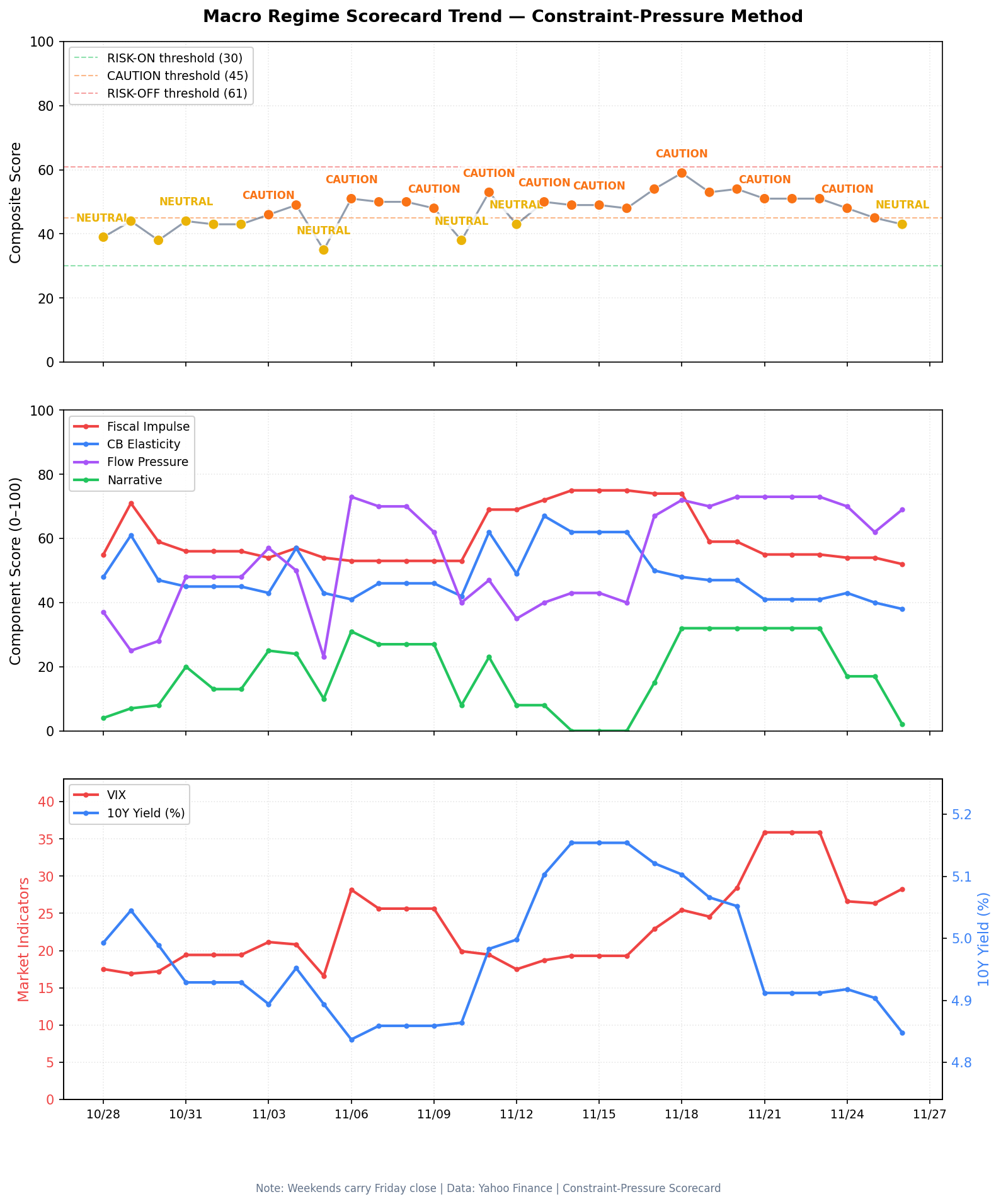
43 of 100 sits in NEUTRAL. Caution starts at 45, risk-off at 61, risk-on below 30.

Variable Score Interpretation
Fiscal Impulse52Down two points. The 10 year index closed Wednesday at 4.848 percent, down 5.6 basis points. The yield eased. It did not break
CB Elasticity38Down two points. The 5 year index closed at 4.660 percent. The futures path did not ease with this line. A December quarter point is priced at 98 percent
Flow Pressure69Up seven points. The volatility index closed at 28.29, from 26.36. This is the line that did not agree with the label
Narrative Coherence2Down fifteen points. The drop carried the score across the line. The cash tape was still a split
Composite43NEUTRAL

The label changed. Yesterday's score was 45, CAUTION. Today's score is 43, NEUTRAL. RISK-ON is below 30. CAUTION runs from 45 to 60. RISK-OFF is 61 and above. A higher score means more stress. Two points crossed the floor of CAUTION because the narrative line fell, not because volatility eased. Flow rose. It is not a reason to buy the rescue, to cover duration, or to add the crude residual because the settlement rose.

Data through the 25 Nov 2026 US close. This is a Thursday morning note. The score uses Wednesday's volatility index of 28.29 and Wednesday's 10 year index of 4.848 percent.

Score trend, thirty days

Macro regime composite score, last thirty days, with the neutral and caution lines
One point a day. The composite is the same four components, weighted the same way, thirty days back.